OrgX is in the ChatGPT plugin directory
Connect your OrgX workspace to ChatGPT and start with the decisions and project context your team has already recorded.
OrgX / Journal
What we learn building AI work that carries its context forward. Experiments, engineering decisions, and the evidence behind them.
Featured field note
Open standard · Jul 22, 2026
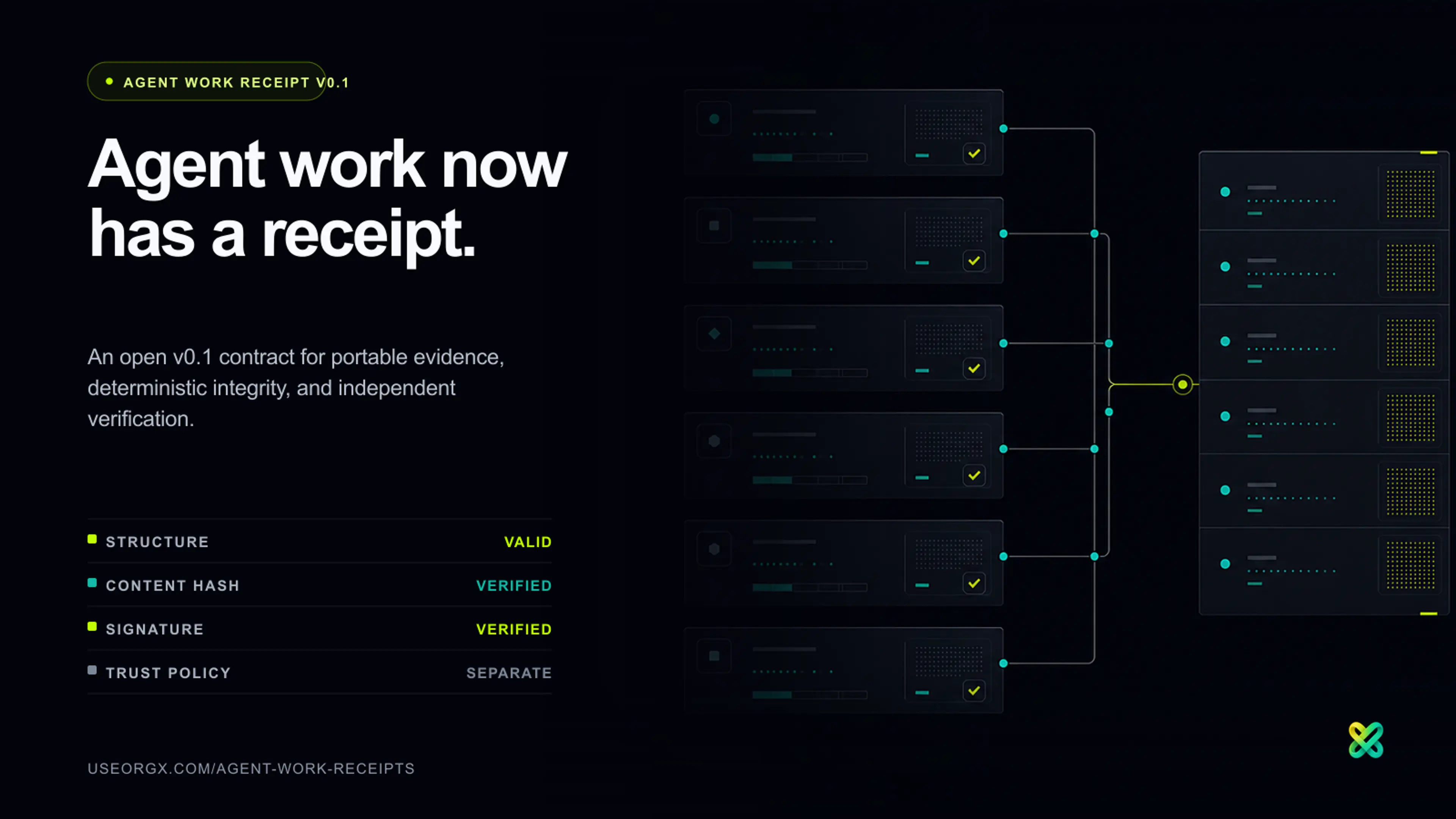
Agent Work Receipt v0.1 is an open, account-free contract for portable evidence, deterministic integrity, and independent verification across agent runtimes.
19 articles
Connect your OrgX workspace to ChatGPT and start with the decisions and project context your team has already recorded.
A reusable handoff template and a fresh-session test for carrying decisions, rationale, owners, artifact versions, and permission boundaries between AI agents.
A practical closeout packet for AI agencies: scope, versioned deliverables, evidence, exceptions, named acceptance, and the next action.
Handing real work to agents takes two records: what an agent may do before it acts, and who accepted what it produced afterward. OrgX keeps both on the same initiative.
Braintrust and Basis made agent behavior testable. The next primitive makes the judgment cumulative: an open work receipt that binds a behavior verdict to authority, artifacts, cost, and human acceptance.
Agent Work Receipt v0.1 is an open, account-free contract for portable evidence, deterministic integrity, and independent verification across agent runtimes.
OrgX’s pricing hypothesis is testable: a linked delivery record should help a reviewer find the agreed scope, supporting evidence, and client ruling with less reconstruction. This essay explains how to compare that work.
OrgX-Bench V1.2 adds solution-equivalence audits, counterfactual twins, contamination burn rules, statistical precision, and public corrections before any frontier headline can ship.
The OrgX autonomous initiative benchmark had a quiet rot problem: its judge panel pointed at models that no longer exist. We fixed it, re-ran the full catalog on current GA models, fixed a cost bug along the way, and tied the autonomy score to the gated-autonomy controls that now ship in OrgX.
Ten requests each to health, metadata, and public tool discovery provide a narrow endpoint baseline. They do not establish authenticated workflow speed or a competitive advantage.
Keep the request, governing decision, artifact version, and owner review together. Then check whether the next person or agent can retrieve the records before continuing.
An archived 136-run experiment tested how prior-state summaries affect dependent work. The configurations explain the comparison; unreconciled numerical averages are withdrawn, and the raw run was not publicly released.
OrgX Wizard helps configure supported AI clients for an OrgX workspace. Review the changes, complete authentication, and retrieve a known record to check the connection.
The point was not volume. It was forcing the system to find the few ideas with enough pain, specificity, and visual tension to deserve production.
The OrgX autonomous initiative benchmark now publishes generated artifacts, independent judgments, token-level costs, and the failures that still need human review.
AI content looks like slop when a model is asked to carry taste, memory, and QA by itself. The fix is not a better prompt. It is a content system.
Wearing many hats is not a founder superpower. It is a coordination failure wearing a flattering name. The founder should not have to be the operating system.
OrgX MCP connects supported AI clients to recorded initiatives, decisions, and artifacts. Check one known record and its source before continuing; cross-client recovery remains partial beta support.
How OrgX-Bench separates public mechanism runs from private headline evidence, measures benchmark error, and evaluates trustworthy initiative completion.